About
I started from operations, which is why I design from the failure case.
Nearly five years delivering Salesforce across real estate, logistics, and e-commerce — most of it at the seam where Salesforce has to agree with an ERP, a warehouse system, or a government registry.
The short version
Nearly five years, three industries
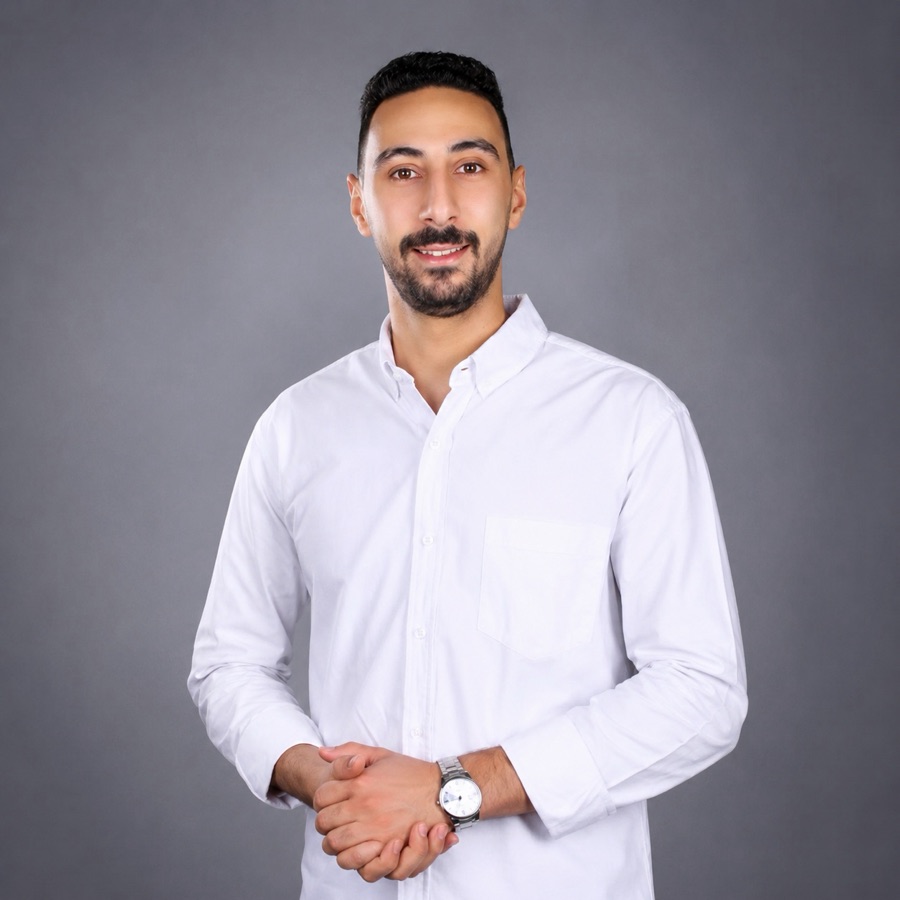
I began as a Salesforce administrator at a consultancy in 2022, working across several client industries at once. That start matters: before I wrote much Apex, I spent a year watching what actually breaks in a live org — permissions nobody documented, automation layered on automation, and processes that only worked because a particular person remembered a particular step.
From there the work moved toward development and then integration. At Marakez I delivered the Salesforce integration with Oracle Fusion Accounts Receivable — and found that a custom payment-plan engine was calculating Net Present Value incorrectly, which meant the instalment schedules going out to property buyers were wrong. Correcting that taught me more than the integration did: financial logic fails plausibly, and nothing catches it except checking the arithmetic.
At Khazenly I owned the Salesforce side of warehouse and fulfilment integration end to end — the data model, the API surface, the reconciliation logic, and the interface people actually used, with AWS Lambda as the middleware between Salesforce and external delivery providers. At IBM I saw how enterprise delivery works when governance, knowledge transfer, and formal standards are not optional.
Today I am a Senior Salesforce Developer at Emaar in Dubai, where I designed and implemented the end-to-end integration with the Dubai Land Department and OQOOD systems that automates property unit registration. The constant across all of it has been the same: the interesting problems are almost never inside Salesforce. They are at the boundary, where Salesforce has to agree with something it does not control.
Philosophy
“I believe great Salesforce solutions begin with understanding business requirements rather than technology. My goal is to build scalable, maintainable, and reliable solutions that continue delivering value as organizations grow.”
Mohamed Ali — Senior Salesforce Engineer
Engineering philosophy
Six positions I actually hold
Each of these is a position with a cost, not a preference. Where one is visible in the work, there is a link to where you can check it.
01
Start from the business question, not the platform feature
A solution that cannot be explained to the person who asked for it is not finished. I start from the operational question — "did we receive what the merchant declared?" — and let that determine the design, rather than starting from the platform feature I would like to use.
Seen in: the reconciliation view, not a sync job02
Design for the failure case first
The happy path is the easy part. What determines whether an integration survives is what happens when the other system is down, slow, or returns something the contract did not describe. I decide that behaviour before I write the callout, not after the first production incident.
Seen in: the capture/consume pipeline03
The data model is the real architecture
Most of what looks like application complexity is a data model that did not describe the business accurately. Modelling expected and actual as separate records, or uncertainty as a field rather than a sentence, removes whole categories of downstream work.
Seen in: expected vs. actual receiving items04
Configuration belongs in metadata, not in code
Endpoints, weights, thresholds, and credentials change on a different schedule than logic does. When they live in Custom Metadata, a change is a configuration update rather than a deployment — and a reviewer can read every number that affects behaviour without reading Apex.
Seen in: rubric-as-data scoring05
Put the deterministic work in deterministic code
Anything that must be reproducible, auditable, or explainable should be computed in code you can test — not delegated to a system whose output varies. That applies to reconciliation arithmetic as much as it does to model output.
Seen in: Apex computes the score, the model only judges06
Maintainability is a deliverable
The person maintaining this in two years may not be me. Naming, test coverage, an isolated integration seam, and written-down decisions are part of the work, not an optional follow-up phase.
How engagements run
Business language first, then the technical decision
The same five steps whether it is a two-week integration or a multi-quarter build.
- 01
Understand the operational question
What decision is being made, by whom, on what data, and what happens today when it goes wrong. Before any platform discussion.
- 02
Model the data and the contracts
Objects, relationships, and the exact shape of every inbound and outbound payload — including what each side does with a malformed one.
- 03
Design the integration and failure behaviour
Synchronous or queued, retry policy, idempotency, where configuration lives, and how a failure becomes visible to a human.
- 04
Build with tests against the seam
External services sit behind an interface with a mock double, so behaviour is provable without a live callout.
- 05
Hand over in writing
Architecture, decisions and their trade-offs, known limitations, and what I would improve next. Documented, not implied.
Career
The path so far
Nov 2025 — Present
Emaar
Senior Salesforce Developer
CurrentDesign and delivery of enterprise Salesforce solutions, including the end-to-end integration with Dubai’s property registration authority, with production stability as a standing constraint.
Jun 2025 — Nov 2025
IBM
Application Developer — Salesforce
Enterprise delivery inside a formal governance and release-management framework, in a large-scale consulting environment.
Oct 2024 — Oct 2025
Khazenly
Salesforce Developer
Owned Salesforce delivery for logistics, warehouse, and order-management operations, including the integration layer between Salesforce and external delivery providers.
Dec 2022 — Jul 2024
Marakez
Senior IT Applications Engineer → IT Applications Engineer
Salesforce development and platform ownership for operational and financial business processes, including the integration with the finance system of record.
Jun 2022 — Jul 2023
ScaleUp
Salesforce Support Specialist
Platform administration and end-user enablement for a mid-sized sales and marketing team.
Feb 2022 — Nov 2022
Cloud 11
Salesforce Administrator
First Salesforce role — consultancy delivery across several client projects, from requirements discovery through to configuration.
May 2020
Bachelor of Computer Science
Faculty of Computer and Informatics, Benha University. Graduation project: Smart Waste Basket — graded Excellent.
Looking ahead
In developmentOptimalX — Founder
The commercial identity I am building for consulting work — Salesforce consulting, enterprise integrations, CRM implementation, workflow and process automation, AI-enabled business solutions, and custom business software.
Early stage, and intentionally not presented as an established practice. Engagements today are with me directly.
The best version of this conversation starts with your problem, not my CV.
If something in your Salesforce estate is unreliable, undocumented, or about to be rebuilt, describe it and I will tell you honestly what I think it needs.